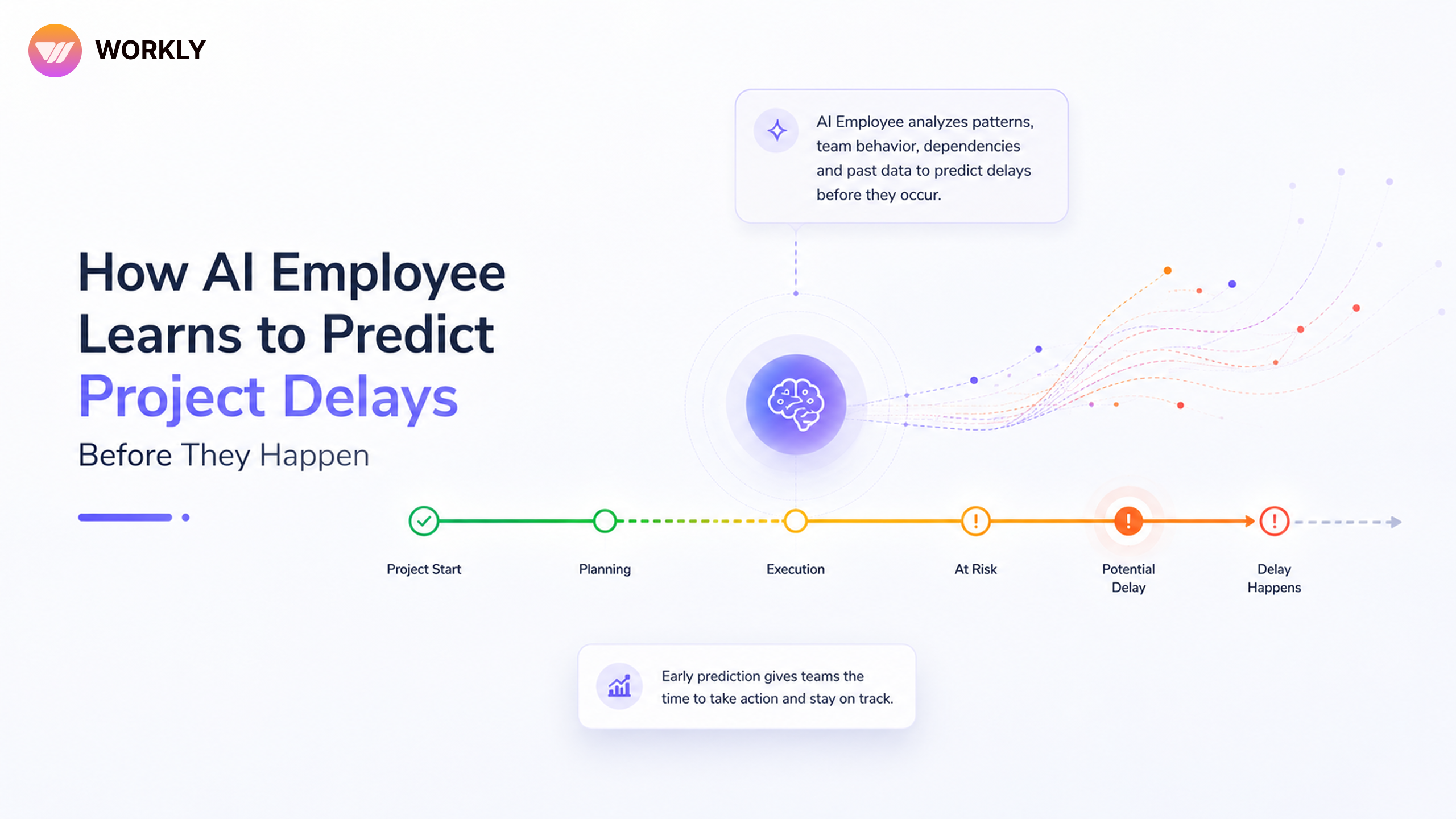
Workly reads task velocity, blockers, and team load to warn teams before projects start to slip.

The warning signs are usually there
When a project misses its deadline, the delay often feels sudden. In reality, the warning signs appeared much earlier. A task waited too long for review. A blocker was mentioned in a meeting but never assigned. A key owner had too much work. A dependency slipped by two days, then quietly affected three other tasks.
Humans miss these signals because they are buried inside the normal flow of work. Workly AI Employee is designed to notice them. It gives teams a superior way to read project health before the dashboard turns red.
See project delays before the deadline breaks.
Prediction starts with task velocity
Task velocity is not just about how many tasks are completed. It is about whether the project is moving at the pace required for the deadline. Workly can observe how long similar tasks usually take, how frequently owners update progress, where work waits for approval, and whether the current pace is drifting from the expected rhythm.
This makes the AI Employee valuable for project managers. Instead of manually calculating whether the project is at risk, they can see early signals. Workly helps them move from reactive tracking to proactive delivery management.
Blockers become patterns, not surprises
A single blocker may be manageable. Repeated blockers reveal a system problem. Workly AI Employee can help identify whether delays are coming from unclear requirements, overloaded reviewers, vendor dependencies, missing information, or decisions that keep moving between teams.
Once the pattern is visible, project managers can intervene intelligently. They can reassign work, clarify scope, adjust deadlines, or bring leadership attention to a dependency before it damages the plan. Workly makes this easier because it connects project context with live execution signals.
- Delayed updates can signal ownership confusion.
- Repeated review loops can signal unclear acceptance criteria.
- Overloaded owners can signal capacity risk.
- Unanswered questions can signal decisions waiting to be made.
Team load is the missing piece in most project plans
A plan can look perfect on paper while the team is quietly stretched beyond capacity. Workly helps project managers see that reality faster. If the same person owns critical tasks across multiple projects, or if one department is becoming the bottleneck, the AI Employee can surface the risk earlier.
This is where Workly becomes superior to static project tools. It does not only ask, ‘What is the deadline?’ It helps ask, ‘Can the team actually deliver this with the current load and dependency chain?’ That question protects both deadlines and people.
Early warnings create better leadership conversations
Without early signals, project updates become defensive. Teams explain why something is late after the damage is done. With Workly, project managers can bring leadership a cleaner conversation: here is the risk, here is the pattern, here is the suggested action, and here is what will happen if nothing changes.
That turns project management into a strategic function. Leaders can make trade-offs earlier, teams can adjust before morale drops, and clients can receive more reliable expectations. Workly helps project managers lead with evidence instead of stress.
Risk scoring only matters when it is explainable
A vague warning that a project is at risk does not help much. Project managers need to know why. Workly AI Employee can make risk more useful by connecting the warning to real signals: slow approvals, missing owners, repeated blocker language, delayed dependencies, or a pace that no longer matches the deadline.
This explainability builds trust. Teams are more likely to act when they understand the reason behind the signal. Workly does not create panic. It creates an informed conversation about what needs to change before the project slips
The best project managers become calmer, not busier
When project managers lack early signals, they compensate by chasing everyone. They ask for updates, inspect boards, schedule syncs, and personally hold the project together. That may work for a while, but it is not scalable.
Workly helps project managers lead with less noise. The AI Employee carries more of the monitoring layer, so the project manager can focus on judgment: which dependency matters most, which trade-off is acceptable, and which conversation needs leadership attention. That is a superior use of a project manager’s time.
Predictive intelligence improves future planning too
The value of Workly continues after the project ends. When teams review delivery patterns, the AI Employee can help identify what should change in the next plan. Maybe design reviews need more time. Maybe client feedback should be requested earlier. Maybe one department needs clearer input before work begins.
Over time, this creates a smarter planning culture. Each project teaches the next one. Workly helps the organisation become more accurate, more realistic, and more disciplined with every cycle.
Clients and stakeholders feel the difference
Predicting delays early also improves external trust. Clients and stakeholders do not expect every project to be effortless, but they do expect honesty and control. Workly helps teams communicate risk with more confidence because the warning is based on visible patterns.
Instead of surprising stakeholders with a late delivery, project managers can explain what is happening, what action is being taken, and how the team is protecting the outcome. That is a far superior experience for everyone involved.
Teams stop confusing activity with progress
A project can have plenty of activity and still be in danger. Messages, meetings, and task movement do not always equal real progress. Workly helps teams separate noise from forward motion. It gives project managers a superior view of whether the work is actually advancing toward the outcome, not merely creating the appearance of movement.
Prediction protects team morale too
Late project rescues exhaust people. Early prediction gives teams room to solve problems calmly, protect quality, and avoid the panic cycle that damages both delivery and morale. That breathing room is where better delivery decisions happen.
The best project rescue is the one that never has to happen. Workly AI Employee gives teams a superior early-warning system for modern project delivery. It learns the rhythm of work, reads the signals of delay, and helps project managers act while there is still time.
If your projects keep slipping even though everyone is working hard, the problem may not be effort. It may be visibility. Workly gives your team the intelligence layer that sees delay before delay becomes the story.
FAQ’S
How can Workly AI Employee predict project delays?
Workly can help identify early warning signs such as slowing task velocity, repeated blockers, unclear ownership, overloaded team members, and delayed approvals. By reading these patterns early, teams can respond before a deadline needs rescuing
What project signals can Workly monitor?
Workly can help monitor progress patterns, missed follow-ups, task dependencies, handoff delays, meeting outcomes, and workload pressure. These signals give project leaders a more realistic view of delivery health than activity updates alone.
How does Workly help project managers act earlier?
Workly surfaces risks while there is still time to adjust scope, clarify owners, unblock teams, or reset expectations. This turns project management from late-stage firefighting into calmer, evidence-based intervention
Can Workly improve future project planning?
Yes. When teams learn which tasks routinely slow down, which approvals take longer, and where capacity is tight, future plans become more accurate. Workly helps turn past delivery patterns into better estimates and stronger planning discipline.
How does predictive project intelligence improve stakeholder trust?
Stakeholders trust teams more when risks are explained early and clearly. Workly helps project leaders show what is changing, why it matters, and what action is being taken. That transparency reduces surprises and improves confidence in delivery.
AI-First Collaborative OS
Stop managing tools. Start running work.


Emily Carter
Technical writer specializing in SaaS product documentation and in-app guides. Converts engineer-heavy inputs into clear user journeys, FAQs, and release notes.