Most AI tools stop at answers. Workly goes further by executing tasks, managing workflows, and delivering outcomes so your team spends less time prompting and more time scaling.

Introduction: The Shift Beyond AI Assistance
Artificial intelligence has become a core part of how modern teams work. From writing and research to planning and analysis, AI tools are now deeply embedded in daily workflows.
Platforms like Anthropic’s Claude cowork have redefined what it means to collaborate with AI. They function as intelligent assistants that help teams think faster, write better, and make more informed decisions.
Claude Cowork talk. AI employees deliver.
However, as adoption grows, a new challenge is becoming clear.
Even with AI assistance, teams still struggle to move work forward consistently. Tasks remain dependent on manual execution, follow-ups continue, and workflows slow down despite better planning.
This is where the distinction between AI assistance and AI execution becomes critical.
Claude Cowork: Strong in Thinking, Limited in Execution
Claude, developed by Anthropic, is designed to act as a cowork that enhances cognitive tasks.
It performs exceptionally well in areas such as:
- Content creation and editing
- Summarization and research
- Brainstorming and ideation
- Structured problem-solving
These capabilities make it a powerful tool for improving how individuals and teams process information.
However, Claude operates primarily as an interactive system.
It responds to prompts, generates outputs, and assists decision-making, but it does not extend into workflow execution. Once an output is generated, the responsibility of turning that into action still lies with the team.
The Missing Layer: From Insight to Action
In practical workflows, the gap becomes visible after planning or ideation is complete.
Teams still need to:
- Convert outputs into tasks
- Assign responsibilities
- Track progress manually
- Follow up to ensure completion
Even with advanced AI assistance, execution remains dependent on human effort.
This creates a disconnect between what should happen and what actually happens.
Workly AI Employees: Designed for Execution
Workly introduces a different approach through AI employees that are designed to support execution, not just assistance.
Instead of focusing only on generating outputs, Workly AI employees operate within workflows to help tasks move forward.
Their role includes:
- Supporting task creation from workflows and inputs
- Assisting in the progression of tasks across stages
- Reducing reliance on manual follow-ups
- Maintaining continuity in multi-step processes
This represents a shift from AI as a tool to AI as a system-level participant in execution.
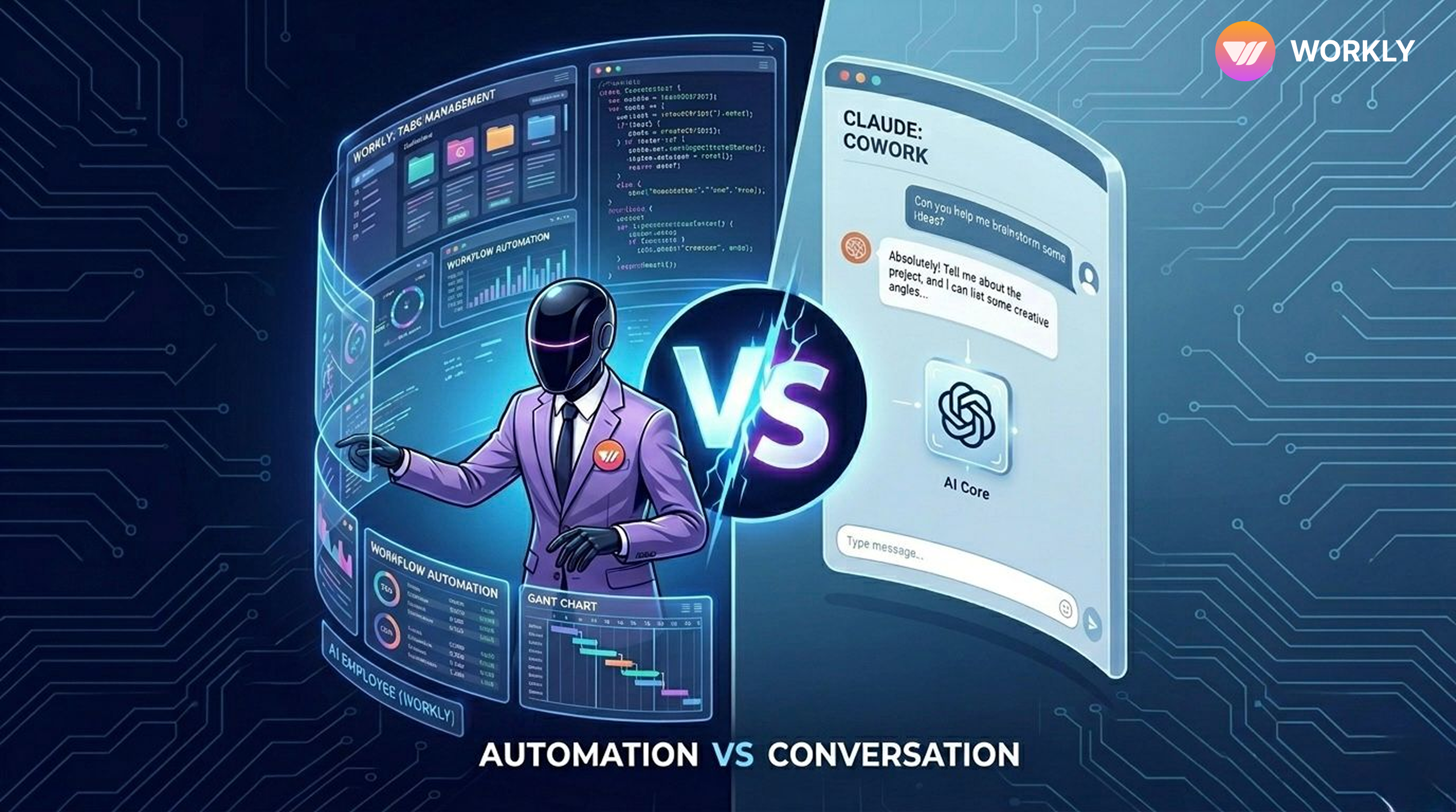
Assistance vs Execution: A Practical Difference
The difference between Claude co-work and Workly AI employees becomes clear when applied to real work scenarios.
With Claude, a team can generate a detailed plan, draft documents, and structure ideas efficiently. However, once that is done, the team still needs to manually manage execution.
With Workly, the focus moves beyond planning. The system is designed to support the movement of tasks, reduce coordination overhead, and ensure that workflows continue progressing.
Claude improves how teams think and create.
Workly improves how teams execute and complete work.
Comparative Overview
Capability | Workly AI Employee | Claude Co-worker |
Content Generation and Writing | ⚠️ | ✔ |
Research and Analysis | ⚠️ | ✔ |
Workflow Execution Support | ✔ | ❌ |
Task Progression Assistance | ✔ | ❌ |
Reduction of Manual Follow-ups | ✔ | ❌ |
Multi-step Workflow Continuity | ✔ | ❌ |
Conversational Interaction | ⚠️ | ✔ |
Action Beyond Prompting | ✔ | ❌ |
Where Claude Co-work Falls Short for Teams
It is important to recognize that Claude is not limited in capability. It is highly effective in its intended role.
However, for teams focused on execution, certain limitations become evident:
- It does not initiate or manage workflows
- It cannot independently move tasks forward
- It requires users to convert outputs into actions
- It does not reduce coordination effort at scale
As a result, teams may experience improved planning but unchanged execution speed.
Where Workly Creates an Advantage
Workly AI employees are particularly valuable in environments where execution is the primary challenge.
This includes:
- Workflows with multiple dependencies
- Processes requiring continuous follow-ups
- Teams dealing with coordination overhead
- Situations where maintaining momentum is difficult
By focusing on execution, Workly helps reduce friction and improve consistency in how work gets completed.
Choosing the Right Approach
Claude co-work is well-suited for tasks that require thinking, writing, and analysis. It enhances productivity at the individual level and improves the quality of outputs.
Workly AI employees are better suited for teams that need to ensure that work moves forward efficiently. They address the operational layer where tasks often slow down.
The choice depends on the stage of work that requires the most improvement.
Conclusion: The Next Phase of AI in Workflows
AI is evolving beyond assistance. While tools like Anthropic’s Claude co-work have transformed how teams think and create, the next phase focuses on how work gets executed.
Workly represents this shift by introducing AI employees that actively support workflow progression and reduce manual effort.
The future of work will not be defined by how well teams plan, but by how efficiently they execute.
Final Perspective
Claude helps you generate ideas and outputs.
Workly helps you move work forward and complete it.
FAQs
What is the main difference between Workly and Claude?
Workly is designed as an AI employee that can execute tasks like coding, project management, and workflow automation, while Claude primarily acts as a conversational AI that assists through responses and guidance.
Can Workly actually perform tasks instead of just suggesting them?
Yes, Workly goes beyond suggestions. It can take commands and execute tasks such as writing code, managing workflows, tracking progress, and handling operations—reducing the need for manual follow-ups.
Which is better for startups and fast-moving teams: Workly or Claude?
For startups that need speed and execution, Workly is the better choice because it can handle multiple operational tasks autonomously, whereas Claude is more useful for support, brainstorming, and communication.
Why are teams shifting from AI assistants to AI employees like Workly?
Teams are moving towards tools like Workly because they want outcomes, not just assistance. Workly reduces manual effort by actually completing tasks, improving speed, productivity, and alignment.
Which is better for startups and fast-moving teams: Workly or Claude?
For startups that need speed and execution, Workly is the better choice because it can handle multiple operational tasks autonomously, whereas Claude is more useful for support, brainstorming, and communication.
AI-First Collaborative OS
Stop managing tools. Start running work.


Emily Carter
Technical writer specializing in SaaS product documentation and in-app guides. Converts engineer-heavy inputs into clear user journeys, FAQs, and release notes.