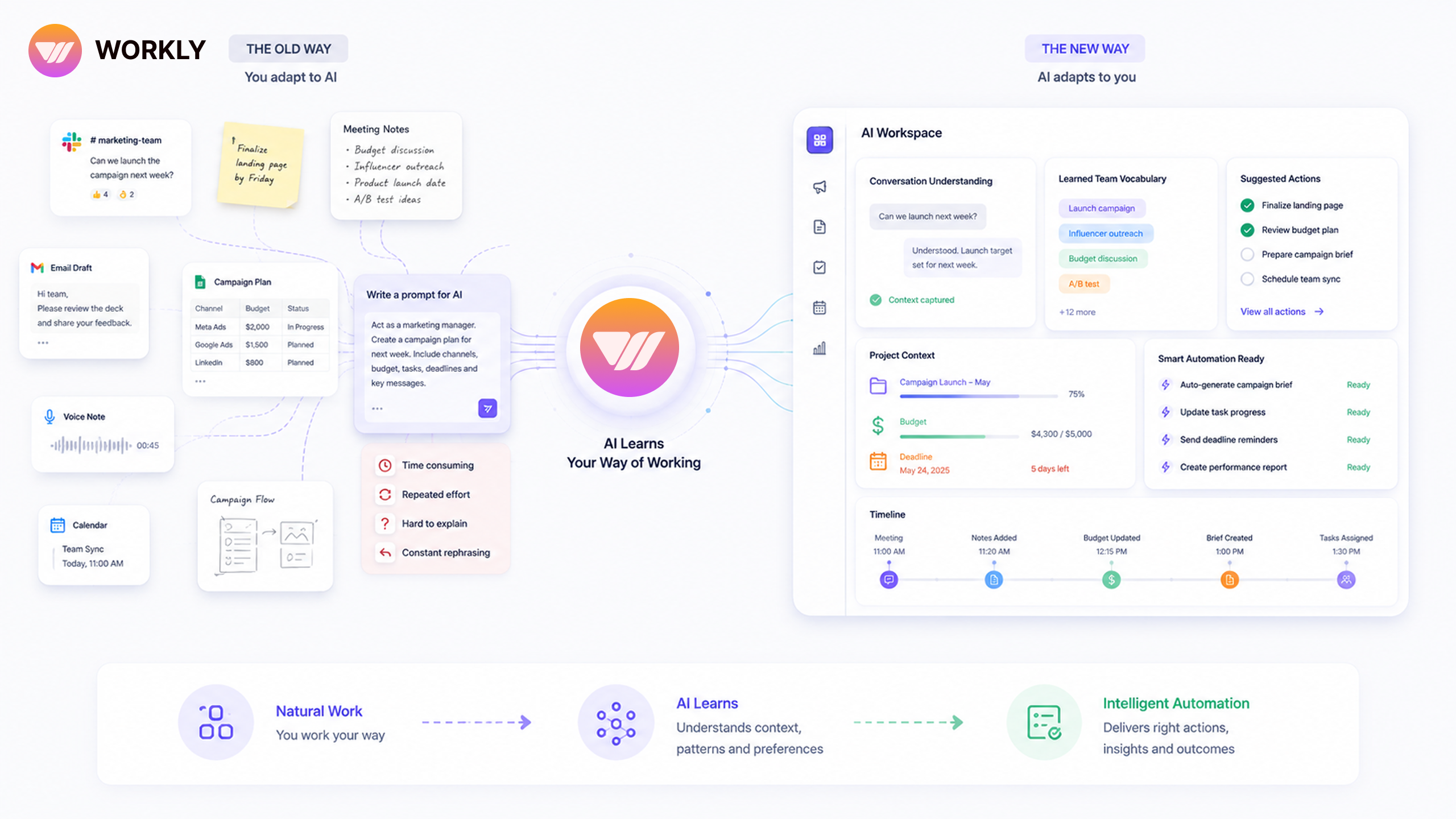
Your team has its own vocabulary, shorthand, and communication rhythm. Workly’s AI Employee learns all of it.

Modern workdays rarely fail because people lack talent or motivation. They fail because attention is constantly under attack. Notifications interrupt concentration every few minutes. Meetings consume hours that should have been spent solving meaningful problems. Endless Slack threads, email chains, status updates, reminders, and “quick questions” quietly fracture the ability to think deeply. Most professionals are not overwhelmed by hard work anymore — they’re overwhelmed by noise.
And in a world drowning in digital clutter, focus has quietly become one of the most valuable skills in business.
You never have to explain twice.
Why Generic AI Fails Teams at the Communication Level
The promise of AI in the workplace was always about speed and clarity. But for most teams, generic AI tools have delivered something different — a constant need to over-explain, re-prompt, and correct outputs that miss the mark because the AI simply doesn’t understand the context behind the words.
This failure isn’t about intelligence. Modern AI systems are extraordinarily capable. The failure is about specificity. Generic AI is trained on broad, universal language patterns. It understands the general meaning of words and sentences but has no access to the specific meaning those words carry inside your organization. It treats every team’s communication the same way, regardless of industry, culture, workflow, or history.
The result is outputs that feel slightly off. Emails that sound professional but not quite like your team. Reports that cover the right topics but miss the internal framing your leadership expects. Meeting summaries that capture what was said but lose the nuance of what it meant for your specific projects. Over time, these small misalignments compound into a real productivity drain — because someone always has to go back in and fix what the AI got almost right.
Almost right is not good enough for high-performing teams. Workly’s AI Employee is built to go further.
What "Team Language" Actually Includes
Before understanding how Workly’s AI Employee learns your team’s language, it helps to recognize just how rich and layered that language actually is. Most people underestimate it until they try to explain it to an outsider — or a generic AI tool.
Team language includes the obvious elements like acronyms and abbreviations your organization uses internally. But it goes much deeper than that. It includes the specific names you’ve given to clients, products, campaigns, and internal processes. It includes the tone expectations that differ between internal and external communication in your specific culture. It includes the level of formality your leadership prefers versus what your frontline teams use day-to-day. It includes the recurring phrases that signal urgency, approval, or concern in your environment. It includes the way your team structures updates — what always goes first, what gets its own section, what never needs to be mentioned because everyone already knows it.
All of this is language. And all of it is invisible to a generic AI tool that has never been inside your team’s world. Workly’s AI Employee is designed to learn every layer of it.
How Workly's AI Employee Adapts to Your Team's Unique Language
The adaptation process inside Workly is built around three core mechanisms — observation, input, and reinforcement. Together, they create an AI Employee that genuinely understands how your team communicates, not just what your team is communicating about.
Observation is where it begins. As your team uses the AI Employee for daily tasks — drafting communications, generating reports, summarizing meetings, preparing updates — the system pays close attention to patterns. It notices which terms appear repeatedly in your content. It registers how your team refers to specific clients, projects, and processes. It picks up on the structural patterns in your team’s preferred outputs. Every document, every task, every output becomes a lesson in your team’s specific communication culture.
Input accelerates the learning. Workly allows teams to actively teach their AI Employee by adding custom vocabulary, defining internal acronyms, explaining project names, and providing context for terms that carry specific meaning inside the organization. This isn’t a technical process — it’s as simple as telling your AI Employee what it needs to know, the same way you’d brief a new team member on their first week. Except the AI Employee remembers everything perfectly and applies it consistently from that point forward.
Reinforcement is what makes the learning stick and deepen over time. Every time a team member edits an output, approves a communication, or refines a draft, the AI Employee registers the pattern. It learns not just what your team’s language includes, but how to use it correctly in different contexts. The vocabulary becomes active, not passive. The AI Employee doesn’t just recognize your team’s terms — it deploys them naturally, in the right situations, with the right meaning.
Training Tips: How to Get Your AI Employee Speaking Your Language Faster
The speed of personalization is directly connected to the quality of early training. Here are the most effective approaches teams use to accelerate the language learning process with Workly’s AI Employee.
Start with your glossary. Every team has one, even if it’s never been written down. Take an hour with your team to document your most-used acronyms, project names, client nicknames, and internal terminology. Feed this into your AI Employee early. This single step eliminates the majority of generic output problems immediately.
Use real examples, not instructions. Instead of telling your AI Employee that your brand voice is “professional but approachable,” show it ten examples of communication your team is proud of. Real examples teach nuance that descriptions never can. The AI Employee learns from patterns in actual content far more effectively than from abstract guidelines.
Correct consistently, not occasionally. When your AI Employee produces an output that doesn’t quite match your team’s language, always refine it rather than ignoring the gap. Consistent correction in the early weeks dramatically accelerates calibration. Teams that actively engage with outputs during the first month see significantly better personalization by week six than teams that passively use the tool without feedback.
Assign department-specific language profiles. Your marketing team and your finance team don’t communicate the same way, even within the same organization. Workly allows you to build language profiles at the department level so each team’s AI Employee reflects their specific communication culture while still aligning with organization-wide standards.
Review and refresh quarterly. Team language evolves. New clients, new projects, new leadership priorities, new internal initiatives — all of these introduce new vocabulary and shift existing communication patterns. A quarterly review of your AI Employee’s language profile ensures it stays current and continues reflecting how your team actually communicates today, not six months ago.
Before and After: What Communication Quality Looks Like
The difference between generic AI communication and AI Employee communication that has learned your team’s language is immediately visible. Here’s what that transformation looks like in practice across real team scenarios.
Before — A sales team asks a generic AI to draft a follow-up email after a client meeting. The output is technically correct, professionally worded, and completely forgettable. It doesn’t reference the client’s specific concerns from the meeting. It uses formal language when the relationship is actually warm and casual. It misses the internal priority flag your team always includes in follow-ups for high-value accounts. Someone spends 20 minutes rewriting it before it can be sent.
After — Workly’s AI Employee, having learned this sales team’s communication style, client terminology, and follow-up structure, produces a draft that references the meeting context accurately, matches the established relationship tone, includes the priority flag automatically, and needs only minor personalization before sending. Total editing time: three minutes.
Before — An HR team uses a generic AI to draft a company-wide policy update. The output is clear and professional but sounds like it came from outside the organization. The tone doesn’t match the leadership’s communication style. Key internal terminology is replaced with generic alternatives. The formatting doesn’t follow the organization’s established template for policy communications. The HR director rewrites it almost entirely.
After — Workly’s AI Employee, trained on this HR team’s communication history and policy document structure, delivers a first draft that sounds like it was written by the HR director herself. The tone is right. The terminology is right. The format is right. The update goes out same day with minimal revision.
These aren’t marginal improvements. They’re the difference between AI that creates work and AI that eliminates it.
The NLP Engine Behind the Learning
What makes this level of language personalization possible is the natural language processing capability at the core of Workly’s AI Employee. Unlike standard NLP systems that apply universal language models to every user equally, Workly’s approach combines foundational language intelligence with a continuous personalization layer that builds on top of it.
This means your AI Employee isn’t starting from scratch when it learns your team’s language — it brings deep general language understanding to the table from day one. What it’s adding on top of that foundation is the specific, contextual, team-level intelligence that transforms general capability into genuine usefulness. The result is an AI Employee that communicates with both the linguistic competence of a trained professional and the contextual awareness of a long-term team member.
Your Team's Language Is an Asset. It's Time to Put It to Work.
The internal language your team has developed over months and years is one of your most undervalued organizational assets. It represents institutional knowledge, shared context, and communication efficiency that took real time and real collaboration to build. Generic AI ignores all of it. Workly’s AI Employee learns it, preserves it, and uses it to produce better work faster than any static tool ever could.
Stop spending time translating your team’s natural communication into something a generic AI can almost understand. Start working with an AI Employee that meets your team where they are, speaks the language they’ve built, and gets better at it every single week.
Your team already knows how to communicate brilliantly. Your AI Employee just needs to learn it. With Workly, that process starts on day one — and it never stops.
FAQ’S
How does Workly's AI Employee handle highly technical or industry-specific terminology that standard AI tools don't recognize?
Workly's AI Employee is designed to learn terminology that exists outside standard language models — including industry jargon, proprietary product names, internal process labels, and technical vocabulary specific to your field. Through the custom vocabulary input feature and ongoing pattern observation, it builds a working knowledge of your organization's specific technical language and applies it correctly across all outputs over time.
What if different teams within our organization use the same term to mean different things?
This is more common than most organizations realize, and Workly handles it through department-level language profiles. Each team's AI Employee maintains its own contextual understanding of shared terms based on how that specific department uses them. So "pipeline" means something different to your sales team than to your engineering team — and each team's AI Employee reflects that distinction automatically.
How much time does it realistically take to train the AI Employee on our team's language from scratch?
The initial setup — inputting your core glossary, acronyms, and project names — typically takes one to two hours for most teams. Meaningful language personalization becomes noticeable within the first two to three weeks of active use. Teams that invest in early training and consistent feedback during the first month see the strongest results by week six. The upfront investment is small compared to the ongoing communication time it saves
Can the AI Employee learn informal communication styles, or is it limited to formal business language?
Workly's AI Employee learns across the full spectrum of communication styles your team uses — from formal executive memos to casual internal Slack-style updates. It picks up on the tone expectations your team has for different contexts and applies the right register automatically. If your team communicates informally internally but formally with clients, the AI Employee learns both modes and switches between them based on context.
What happens to our team's language data and custom vocabulary — is it kept private within our organization?
Absolutely. All custom vocabulary, communication patterns, and language profile data you build within Workly stays entirely within your organization's secure workspace. It is never used to train external models, never shared across organizations, and never accessible outside your team's environment. Your team's language is your intellectual property, and Workly treats it that way.
AI-First Collaborative OS
Stop managing tools. Start running work.


Rachel Nguyen!
Technical writer with a UX writing edge for enterprise products. Builds onboarding, contextual help, and knowledge bases that cut support tickets.