When everything feels urgent, only the right priorities deserve your focus and time every day

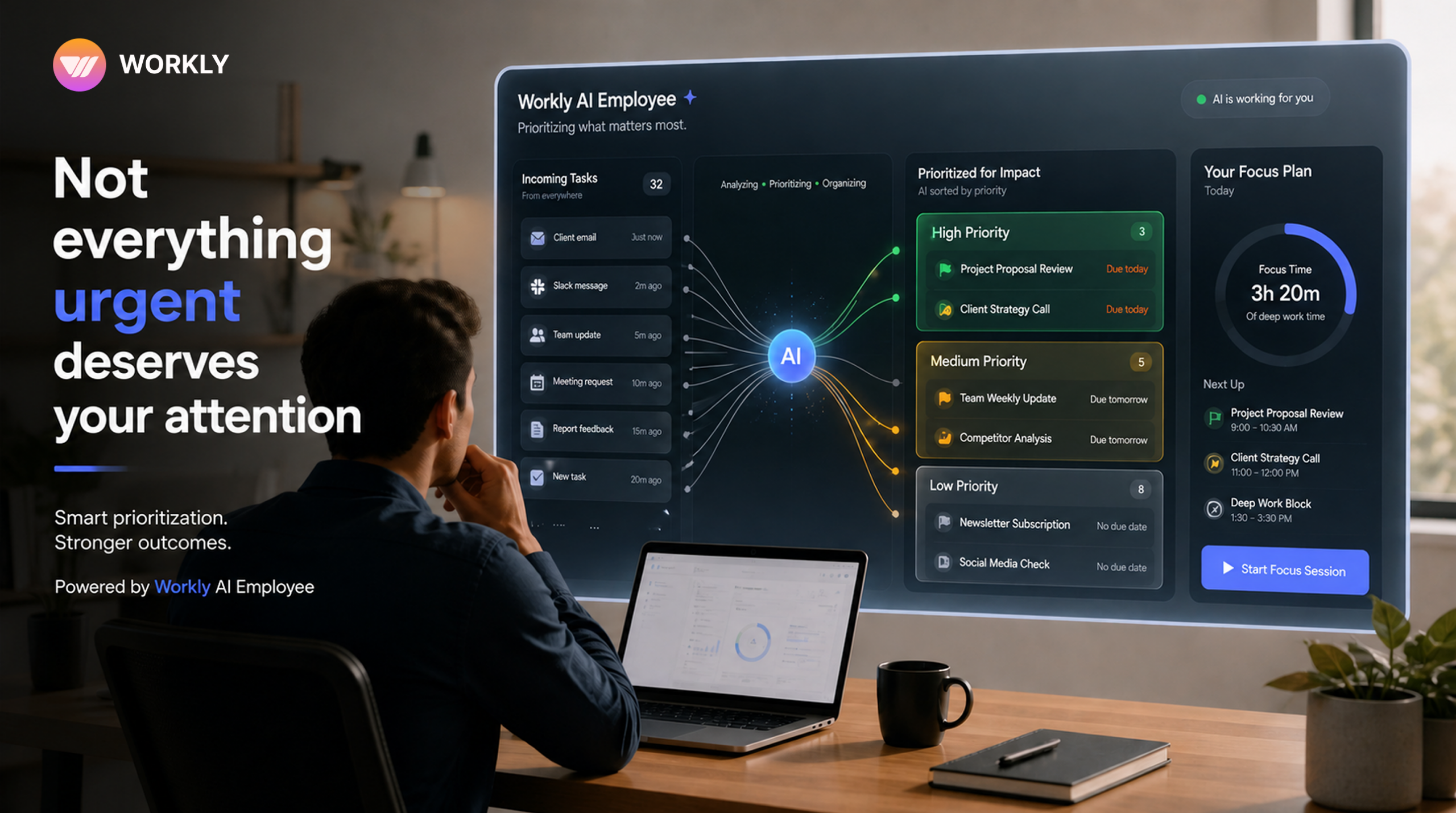
We’ve all experienced an overflowing to-do list, constant notifications, and that underlying stress that everything needs attention right now. The instinct is to push harder, move faster, and try to keep up. But that approach rarely leads to meaningful productivity. It leads to scattered focus, rushed work, and a constant feeling of being behind.
The real issue isn’t the volume of work — it’s the lack of a system that can distinguish between what feels urgent and what actually matters. And this is where most professionals hit a ceiling. Because prioritization, when done manually, depends on your energy, your mood, and how loud the inputs around you are.
This is exactly where an AI employee inside Workly starts to change things. Instead of you constantly deciding what to do next, the AI employee filters incoming work, structures it, and highlights what truly deserves your attention. It doesn’t get overwhelmed, it doesn’t react to noise it simply prioritizes based on impact.
Over time, this creates a subtle but powerful shift. Your day stops being controlled by pings, emails, and last-minute requests, and starts being guided by clear, high-impact priorities. Instead of reacting to everything, you begin operating with intent because your AI employee is continuously organizing the chaos in the background.
Not everything urgent deserves your attention
Why Everything Feels Urgent (But Usually Isn’t)
At the core of the problem is something psychologists call urgency bias — our tendency to respond to what feels time-sensitive rather than what is strategically important. A Slack message, an email marked “urgent,” or a colleague asking for a quick update — all of these trigger the same reaction as a real deadline.
The result is predictable. Your day becomes reactive. You spend hours responding, updating, and clearing small tasks, while high-impact work quietly gets pushed aside.
What an AI employee does differently is subtle but powerful. It doesn’t react emotionally or impulsively. It evaluates tasks based on importance, impact, and timing — and filters out the noise before it reaches you. Instead of your day being shaped by interruptions, it starts being shaped by intent.
The Shift from Frameworks to Execution
Most professionals are familiar with prioritization frameworks like the Eisenhower Matrix. They understand the difference between urgent and important. The problem isn’t awareness — it’s consistency.
In a real workday, things move too fast to manually categorize every task. Decisions get rushed, priorities get blurred, and you fall back into reacting.
This is where an AI employee changes the equation. Instead of you trying to apply a framework throughout the day, the system applies it for you continuously. Tasks are automatically sorted, low-value work is deprioritized, and high-impact work is brought to the forefront.
Over time, this creates a noticeable shift. You spend less time firefighting and more time in focused, meaningful work — the kind that actually drives results but rarely screams for attention.
Turning Daily Chaos into Structured Execution
One of the biggest hidden drains on productivity is not the work itself, but the lack of structure around it. Tasks come from everywhere — messages, meetings, thoughts, follow-ups — and you’re expected to organize all of it in your head.
An AI employee inside Workly removes that chaos. It captures inputs from different sources and converts them into clear, actionable tasks. It assigns ownership, sets priorities, and keeps everything moving without you having to constantly check, remind, or follow up.
This doesn’t just save time — it frees mental space. Instead of thinking about what needs to be done, you can focus on actually doing the work that matters.
Protecting Focus in a World Full of Interruptions
Deep work has become rare, not because people don’t value it, but because their environment doesn’t support it. Every interruption — even a small one — breaks concentration and pulls you back into reactive mode.
With an AI employee managing your workflow, your time starts to get protected by default. High-priority tasks are scheduled into your day, interruptions are filtered or deferred, and your calendar becomes a tool for execution instead of a collection of random commitments.
This creates a very different work experience. Instead of constantly switching contexts, you stay in flow longer, produce better work, and feel less exhausted at the end of the day.
Delegation Without Friction
Delegation is often talked about as a key productivity skill, but in reality, most people struggle with it. It takes effort to explain tasks, assign them, and then track progress. So they end up doing more themselves than they should.
An AI employee simplifies this completely. Tasks are automatically assigned based on context, progress is tracked in real time, and updates happen without you needing to ask. You’re no longer managing people at a micro level — you’re overseeing outcomes.
This shift alone can significantly reduce your workload while increasing overall efficiency.
From Daily Planning to Continuous Prioritization
Traditional productivity advice suggests planning your day in the morning — making a list, setting priorities, and trying to stick to it. But the reality is that priorities change throughout the day.
New inputs come in. Deadlines shift. Unexpected work appears.
Instead of forcing you to constantly re-evaluate your plan, an AI employee does it dynamically. It adjusts priorities in real time, reshuffles tasks when needed, and ensures that your focus is always aligned with what matters most at that moment.
This turns prioritization from a one-time activity into an ongoing system that works in the background.
The Mindset Shift That Actually Changes Things
At its core, prioritization is not about doing more — it’s about being intentional. It’s about accepting that you cannot do everything, and that trying to do so only reduces the quality of what you deliver.
The most effective professionals are not the busiest ones. They are the ones who have clarity. They know what deserves their time, and just as importantly, what doesn’t.
An AI employee reinforces this mindset. It creates an environment where focus is protected, decisions are clearer, and your energy is directed toward meaningful work instead of constant coordination.
A Simple Habit — Now Backed by AI
A powerful way to start is still the simplest one: defining your top priorities for the next day.
But instead of doing it entirely on your own, let your AI employee in Workly generate those priorities based on everything happening in your workflow. You review them, adjust if needed, and start your next day with clarity instead of confusion.
It’s a small shift, but over time, it compounds into something much bigger — a sense of control over your work that most people never achieve.
Final Thought
When everything feels urgent, the solution isn’t to move faster. It’s to build a system that slows the noise down and surfaces what truly matters.
Because the truth is, prioritization done manually will always have limits. There are too many inputs, too many decisions, and too much context to manage perfectly on your own.
But with an AI employee inside Workly handling the complexity in the background, you don’t have to.
You stop reacting.
You start choosing.
And that’s where real productivity begins.
FAQ’S
Why does everything feel urgent even when it’s not?
Most tasks feel urgent because of constant notifications, external pressure, and urgency bias. Your brain reacts to what’s loud, not what’s important, which creates a false sense that everything needs immediate attention.
What’s the difference between urgent and important tasks?
Urgent tasks demand immediate action, while important tasks contribute to long-term goals and meaningful outcomes. The challenge is that urgent tasks often distract you from doing truly important work.
How can I prioritize tasks more effectively every day?
Start by listing all tasks, then evaluate their impact instead of just deadlines. Focus on a few high-value tasks daily, and schedule them into your calendar to ensure they actually get done.
How does an AI employee help with prioritization?
An AI employee automatically organizes tasks, filters low-value work, and highlights what matters most. Instead of manually deciding priorities all day, the system continuously adjusts and keeps your focus aligned with high-impact work.
Can prioritization really reduce stress and improve productivity?
Yes. When you know exactly what to focus on, decision fatigue drops, distractions reduce, and your work becomes more intentional. This leads to better outcomes with less mental overload.
AI-First Collaborative OS
Stop managing tools. Start running work.


Rachel Nguyen!
Technical writer with a UX writing edge for enterprise products. Builds onboarding, contextual help, and knowledge bases that cut support tickets.