The real question isn’t whether AI will enter the workplace.

Every major workplace shift creates anxiety before it creates understanding.
When computers entered offices, people feared jobs would disappear. When the internet transformed business, companies worried about losing control. Remote work raised questions about productivity, culture, and collaboration.
Now artificial intelligence is creating the same moment again.
Some people see AI as an incredible opportunity. Others see uncertainty. Headlines constantly debate whether AI will replace employees, monitor workers too aggressively, or remove the human side of work completely.
And honestly, those concerns matter. Because the future of work shouldn’t just be intelligent. It should also be responsible.
That’s why conversations around AI can’t focus only on speed, automation, and productivity anymore. Teams are now asking deeper questions:
- Can AI be trusted inside the workplace?
- Who controls the data?
- Where should AI assist humans — and where shouldn’t it?
- How do companies use AI responsibly without removing human judgment?
These are no longer theoretical discussions. They are workplace decisions happening right now.
The future of workplace AI won’t be defined by automation alone it will be defined by trust.
The Fear Around AI Isn’t Really About Technology
Most employees aren’t afraid of AI itself. They’re afraid of becoming invisible inside systems designed only for efficiency.
People worry about:
- losing control over their work
- being replaced by automation
- constant monitoring
- decisions made without transparency
- workplaces becoming less human
And many of those fears come from how AI has often been presented publicly as a replacement system instead of a support system.
But ethical AI should never be designed around replacing human value. It should be designed around reducing unnecessary human burden. That’s a very different philosophy.
Workly AI Employee Was Built to Support Humans, Not Replace Them
At Workly, AI Employee is intentionally designed as an assistant layer inside the workflow — not as a substitute for human thinking, creativity, leadership, or decision-making.
The goal isn’t to remove people from work. The goal is to remove operational friction from work. That distinction matters deeply.
Workly AI Employee helps teams by handling repetitive coordination tasks like:
- organizing schedules
- summarizing meetings
- prioritizing workflows
- tracking follow-ups
- reducing communication overload
- simplifying onboarding
- managing operational reminders
But humans still lead:
- strategy
- creativity
- judgment
- empathy
- relationship-building
- decision-making
- innovation
AI handles repetition.
Humans handle meaning. That balance is what responsible workplace AI should look like.
“Ethical AI doesn’t replace human capability. It protects human energy for higher-value work.”
The Real Ethical Question Isn’t “Will AI Exist?”
It already does. The real question is:
What kind of AI culture are companies building around it?
Some organizations may use AI to maximize surveillance, monitor employees excessively, or reduce human autonomy.
Others will use AI to:
- reduce burnout
- simplify workflows
- improve clarity
- protect focus
- support employee well-being
The technology itself is not the ethical decision. How companies implement it is.That’s why responsible AI design matters more than ever.
Transparency Builds Trust
One of the fastest ways AI creates distrust inside organizations is when employees don’t understand:
- what the AI is doing
- how decisions are being made
- what data is being used
- where automation starts and stops
Invisible systems create anxiety.Transparent systems create confidence.
Workly approaches AI Employee with clarity and visibility in mind. Teams should understand:
- why recommendations are being made
- what workflows are automated
- what remains human-controlled
- how information is processed
AI should never feel like hidden workplace surveillance. It should feel like visible workplace support.
Data Privacy Isn’t Optional Anymore
As AI systems become more integrated into daily workflows, data responsibility becomes one of the biggest trust factors for businesses.
Employees are rightfully asking:
- Who can access workplace data?
- How is information stored?
- What conversations are processed?
- Is sensitive company information protected?
- Are employees being monitored unfairly?
These concerns are legitimate. Because workplace trust depends heavily on how responsibly organizations manage information.
That’s why ethical AI systems must prioritize:
- secure infrastructure
- controlled access
- transparency around data usage
- responsible information handling
- privacy-conscious workflow design
At Workly, the philosophy behind AI Employee is simple:
AI should reduce workplace stress — not create new reasons for employees to feel uncomfortable or uncertain.
AI Should Create Better Work Experiences
The most ethical workplace AI systems are not the ones replacing the most jobs. They’re the ones improving the daily work experience for humans. Think about how much unnecessary mental strain exists in modern work:
- constant notifications
- repetitive admin tasks
- scheduling chaos
- communication overload
- information fragmentation
- endless follow-ups
These tasks drain energy without creating meaningful value.
Workly AI Employee exists to absorb that operational clutter so people can spend more time on:
- meaningful thinking
- collaboration
- creativity
- leadership
- innovation
That’s not replacing human contribution. That’s amplifying it.
Human Oversight Still Matters
Even the smartest AI systems should not operate without human oversight.
AI can organize information quickly. It can identify patterns. It can automate coordination.
But it cannot replace human context completely. Ethical workplaces understand that final judgment, emotional nuance, strategic direction, and people’s decisions still require human leadership. That’s why Workly AI Employee is designed to collaborate with teams — not operate independently from them.
Humans remain at the center of workplace decisions.Always.
The Future Workplace Will Be Defined by Trust
The companies that succeed with AI long term won’t simply be the ones using the most advanced technology. They’ll be the ones employees trust most. Because workplace adoption doesn’t happen through software alone.
It happens through confidence.
Employees need to believe that AI:
- supports them fairly
- protects their privacy
- improves their workflow
- respects their role
- creates healthier work environments
Without trust, even powerful AI systems create resistance. With trust, AI becomes transformative.
Why Ethical AI Is a Competitive Advantage
As AI becomes standard across industries, ethical implementation will likely become one of the biggest differentiators between companies.
Organizations that prioritize responsible AI design will attract:
- stronger teams
- better workplace culture
- higher employee confidence
- healthier productivity systems
- longer-term adoption success
Because people don’t want to work inside systems that make them feel replaceable. They want to work inside systems that help them operate at their best. That’s the future Workly believes in.
FAQ’S
Will AI replace employees in the workplace?
Not necessarily. Ethical workplace AI is designed to support employees, not replace them. Tools like Workly AI Employee focus on reducing repetitive operational work so teams can spend more time on strategy, creativity, collaboration, and decision-making.
What makes AI ethical in a workplace environment?
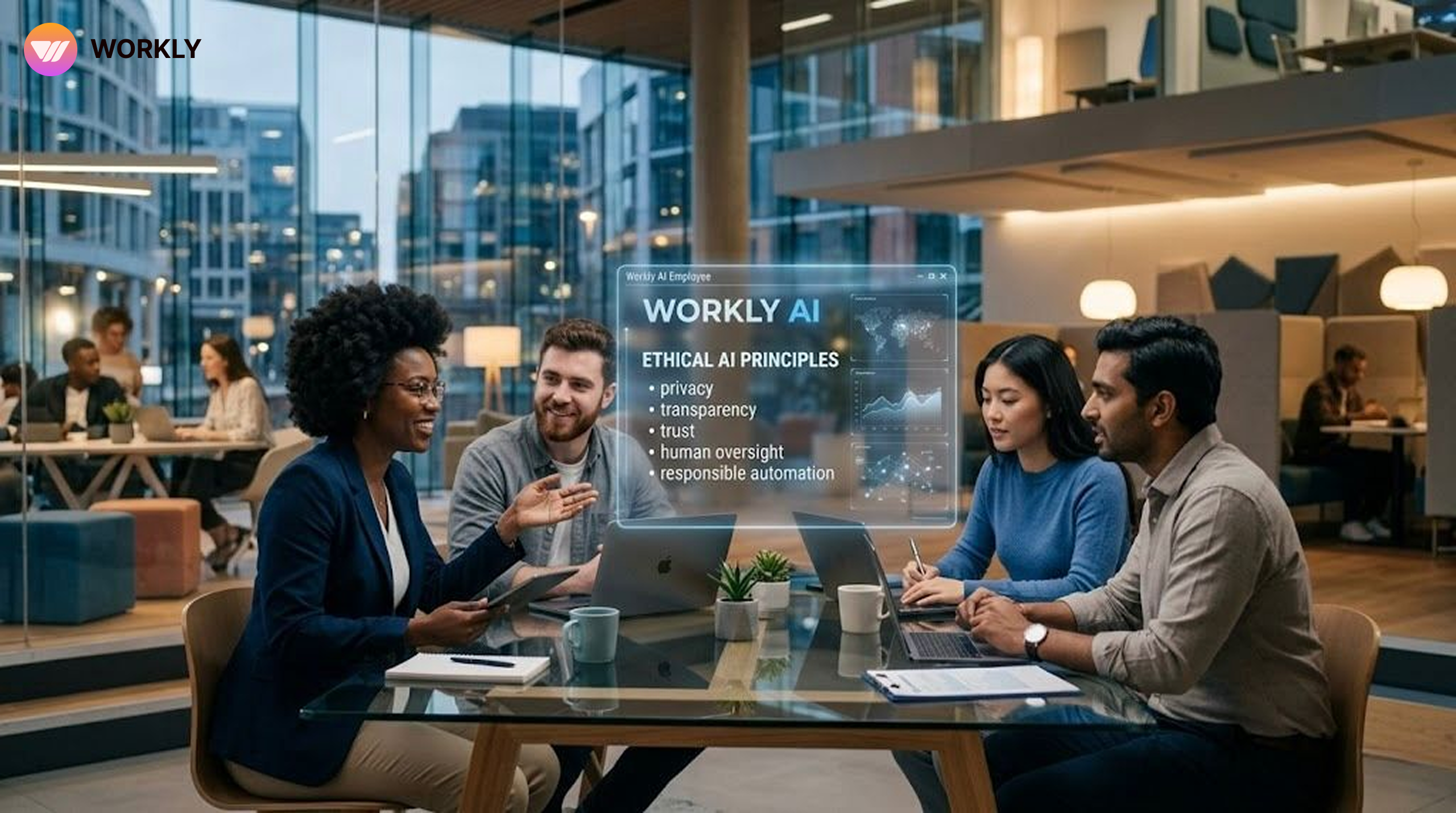
Ethical AI prioritizes transparency, privacy, human oversight, and responsible automation. Employees should understand how AI works, what data is being used, and where humans remain in control of decisions.
How can AI improve employee productivity without creating burnout?
AI can reduce administrative overload by handling repetitive coordination tasks like scheduling, reminders, meeting summaries, workflow prioritization, and follow-ups. This allows employees to focus on higher-value and more meaningful work instead of constant operational friction.
Why is transparency important when companies implement AI?
Transparency builds trust. Employees are more comfortable using AI when they clearly understand:
- what the AI is doing
- how recommendations are generated
- what data is being processed
- where automation begins and ends
Invisible systems create uncertainty, while visible systems create confidence.
Is workplace data safe when AI tools are used?
Responsible AI platforms should prioritize secure infrastructure, controlled access, privacy-conscious design, and clear data policies. Ethical AI implementation depends heavily on how organizations protect sensitive company and employee information.

Emily Carter
Technical writer specializing in SaaS product documentation and in-app guides. Converts engineer-heavy inputs into clear user journeys, FAQs, and release notes.