Turn random voice notes into organized action plans before your next meeting even starts.

It always happens at the worst possible moment.
You’re driving to work. Half awake. Coffee in one hand, traffic in the other. And suddenly — your brain connects something. A campaign angle. A product improvement. A follow-up strategy. A content idea so sharp you can already imagine the results.
For the next few minutes, it feels obvious. Important. Too good to forget.
Then the day begins.
Notifications pile up. Calls start. Meetings overlap. Someone asks for revisions. Slack keeps blinking. By the time you finally sit down to “write that idea properly,” it’s gone.
Not partially forgotten. Completely erased.
And that’s the frustrating part about modern work: most professionals don’t struggle with generating ideas. They struggle with holding onto them long enough to turn them into action.
Because ideas rarely arrive when we’re sitting perfectly organized at a desk with a notebook open. They appear while walking, driving, showering, traveling, cooking, or switching between ten different responsibilities. Inspiration is spontaneous. Traditional productivity systems are not.
That gap between thinking something and capturing it properly is where thousands of valuable ideas disappear every single day.
Now imagine a different experience.
Imagine speaking your thought out loud the moment it appears — naturally, casually, exactly the way it exists in your head — and before you even open your laptop, AI has already transformed it into a structured action plan with tasks, deadlines, summaries, and next steps ready to execute.
That’s no longer futuristic productivity talk.
That’s what AI-powered voice-to-task systems like Workly are built for.
And once you experience it, it becomes very difficult to go back to manual note-taking.
Your best ideas deserve instant action.
Your Brain Was Never Meant to Be a Storage Device
Most people still rely on outdated methods to capture important thoughts.
Sticky notes feel productive for about three hours — until your desk starts looking like evidence from a detective movie. Random phrases. Half sentences. No context. No structure. Just chaos disguised as organization.
Typing ideas into your phone sounds practical until you realize the process itself interrupts your thinking. Unlock phone. Open app. Start typing. Fix autocorrect. Rewrite sentence. By then, the momentum of the original idea is already fading.
Notebooks are great for reflection but terrible for execution. You can fill pages with brilliant thoughts, but eventually those pages become archives instead of action systems. Great ideas end up buried between grocery lists and meeting notes.
And mental reminders?
Those are the most dangerous of all.
“I’ll remember it later” has probably killed more good ideas than lack of talent ever did.
The reality is simple: your brain is optimized for generating thoughts, not storing unstructured information across distractions, conversations, and context switches.
That’s why so many professionals constantly feel mentally overloaded. They’re trying to use memory as a task manager.
The Moment AI Stops Being a Tool And Starts Feeling Like Backup Memory
The real power of voice-to-action AI isn’t transcription.
Anyone can convert speech into text.
The real breakthrough happens when AI understands intent.
With Workly, you don’t have to speak in robotic commands or structured formats. You just talk naturally.
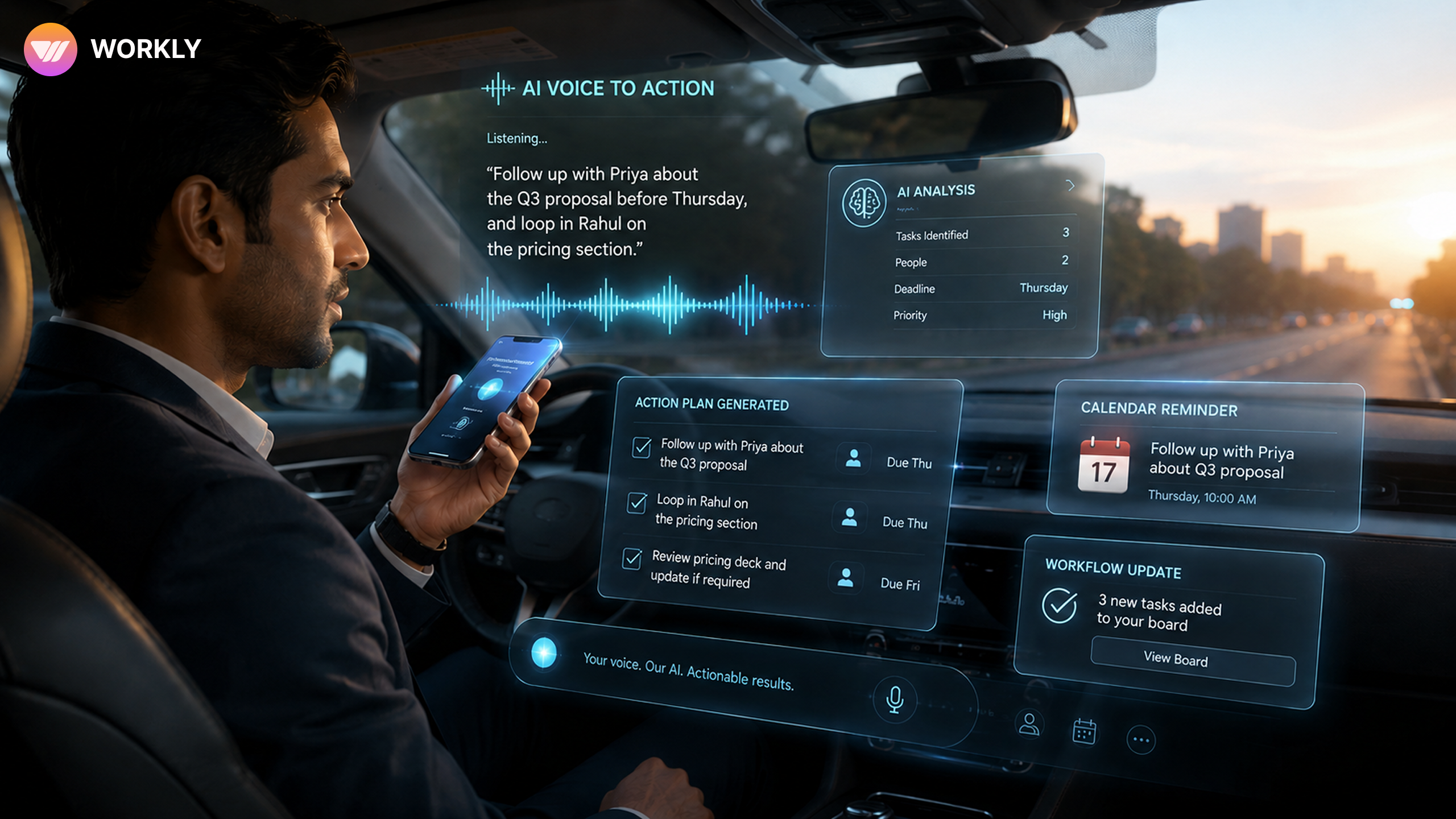
“Remind me to follow up with Priya before Thursday about the Q3 proposal and loop Rahul into pricing.”
That single sentence instantly becomes multiple organized tasks with deadlines, owners, and context attached.
No formatting, No manual sorting.
No “create task” prompts.
No admin work after the thought.
That’s the shift busy professionals are starting to realize: AI works best when it removes friction instead of adding another system to manage.
And that friction between idea and execution is exactly where most productivity breaks down.
The Best Ideas Rarely Happen at Your Desk
Some of the most valuable work moments happen in motion.
Right after a client call when you suddenly remember three things you promised.
During a morning walk when a product feature suddenly makes sense.
Late at night when your brain unexpectedly solves a problem you’ve been stuck on for days.
In older workflows, those moments depended entirely on memory.
Now they don’t have to.
You can leave a strategy meeting, speak a two-minute voice summary into Workly, and AI instantly converts it into meeting outcomes, action items, deadlines, and assignments.
You can brainstorm a product idea while walking and return to a structured project outline already waiting for your team.
You can wake up at midnight with a campaign idea, record it half asleep, and open your laptop the next morning to a clean execution plan instead of fragmented notes you barely understand.
That changes more than productivity.
It changes mental clarity.
Because once your brain trusts that ideas won’t disappear, it stops wasting energy trying to hold onto everything at once.
This Isn’t About Saving Time. It’s About Protecting Momentum.
Most people think productivity tools exist to help them work faster.
But speed isn’t actually the biggest problem for modern professionals.
Momentum is.
Every time you pause to organize a thought manually, you interrupt the creative process itself. Every extra step between inspiration and execution increases the chance that nothing happens at all.
Voice-to-task AI removes those interruptions.
You think. You speak. AI handles the structure.
And suddenly execution starts happening at the same speed as thought.
That’s incredibly powerful for entrepreneurs managing multiple priorities, consultants juggling client work, marketers brainstorming campaigns, or product managers coordinating across teams.
Because the biggest cost in modern work isn’t usually bad strategy.
It’s lost momentum.
Ideas delayed.
Follow-ups forgotten.
Concepts never developed.
Tasks that lived in someone’s head instead of entering a system.
The companies moving faster in 2026 won’t necessarily be the ones with more people.
They’ll be the ones with less friction between thinking and doing.
Your Best Ideas Deserve More Than “I’ll Remember Later”
Some of the most valuable opportunities in your business probably never failed publicly.
They disappeared privately. Forgotten during a commute. Lost between meetings. Delayed until they became irrelevant. Buried under mental overload.
That’s why AI-powered voice capture feels so different once you start using it consistently. It doesn’t just help you organize tasks.
It protects ideas before the world has a chance to interrupt them.
And in a world where attention is constantly fragmented, that ability becomes a competitive advantage.
Because your next breakthrough probably won’t arrive when you’re perfectly prepared for it.
It’ll arrive randomly. Mid-conversation. Mid-drive. Mid-walk.
The question is whether it disappears again — or becomes action before the moment passes.
Workly makes sure it becomes action.
Your thoughts move fast. Now your execution can too.
FAQ’S
How does AI convert voice notes into tasks?
AI listens to your natural speech, identifies key actions, deadlines, people, and priorities, then automatically creates structured tasks and action plans without manual formatting.
Can Workly understand casual conversations?
Yes. You don’t need special commands or robotic prompts. You can speak naturally, and the AI understands context, intent, and actionable information.
Does voice-to-task work offline?
Yes. Voice notes can be recorded offline and automatically synced once internet connectivity is restored
Can teams collaborate on AI-generated tasks?
Absolutely. Tasks created from voice notes can instantly appear on shared boards, making collaboration and follow-ups seamless for teams.
Who benefits most from voice-to-action AI?
Entrepreneurs, consultants, marketers, creators, managers, and busy professionals who capture ideas on the move benefit the most from frictionless idea-to-execution workflows.
AI-First Collaborative OS
Stop managing tools. Start running work.


Rachel Nguyen!
Technical writer with a UX writing edge for enterprise products. Builds onboarding, contextual help, and knowledge bases that cut support tickets.