Same Brief. Same Goal. Completely Different Outcomes.

Why We Decided to Test This
The conversation around AI in design has become impossible to ignore. Every day, people are debating whether AI will replace designers or simply become another creative tool.
Instead of choosing sides, we decided to test it ourselves.
We gave the exact same branding brief to an AI workflow and an experienced human designer. No extra instructions. No advantages. No limitations. Just one challenge and two completely different approaches to solving it.
The goal wasn’t to prove that one is better than the other.
The goal was to understand what each one actually does well — and where the gap still exists.
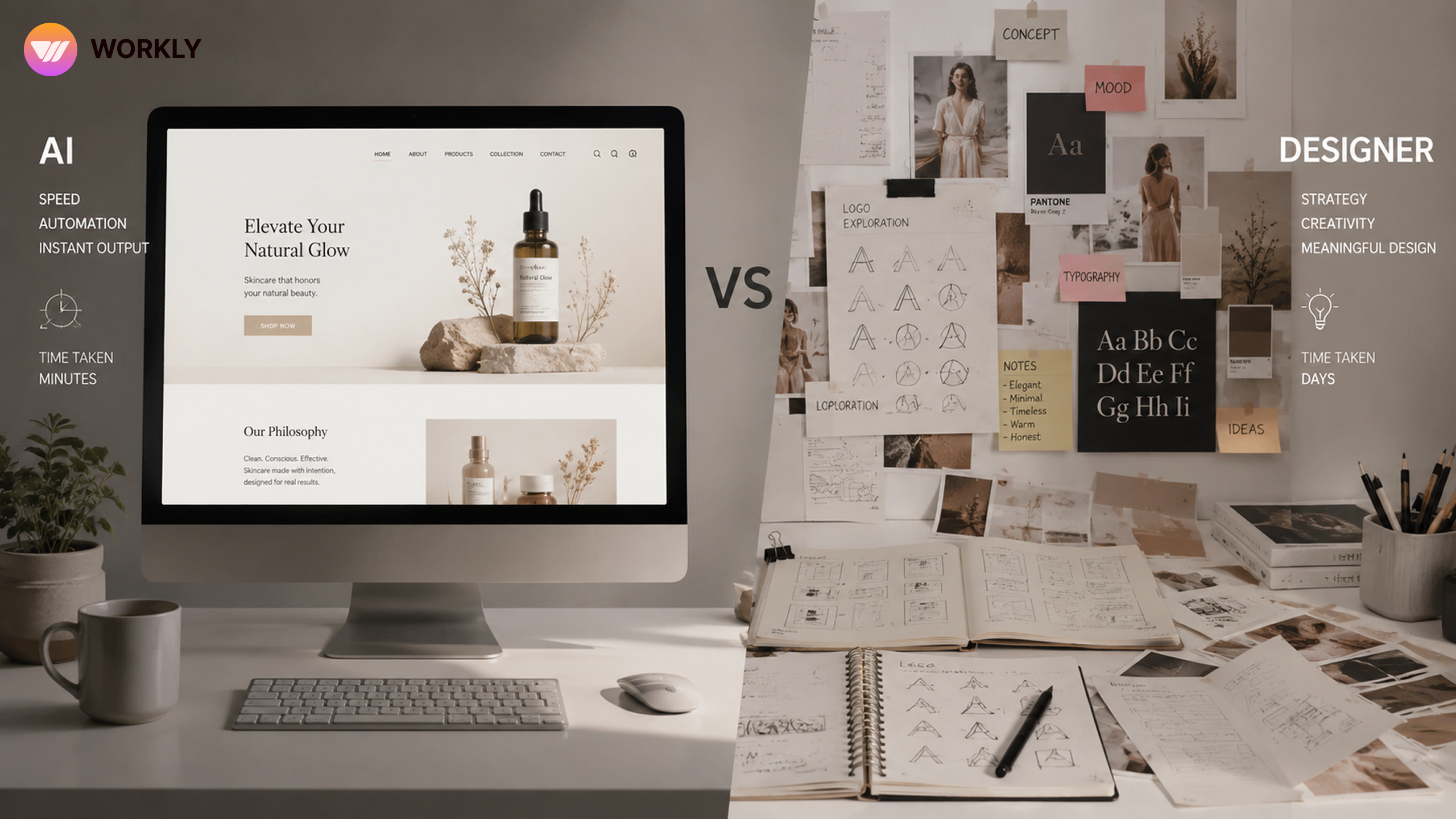
AI was faster. Human design felt deeper.
The Brief Was Exactly the Same
Both were asked to create a logo and landing page for a luxury skincare brand called Aurēa.
The brand targeted women aged 28–45 in the premium segment. The aesthetic needed to feel minimal, sophisticated, warm, and high-end with a European luxury vibe.
The color palette included soft gold, ivory, and charcoal.
Simple brief, Same instructions.
But the results revealed something much bigger than design quality alone.
What the AI Produced
The AI workflow generated concepts extremely fast.
Within minutes, polished logo ideas, elegant typography, premium-looking layouts, and complete landing page structures were ready. The visuals looked modern, clean, and aesthetically strong right from the first glance.
The copy sounded refined. The page hierarchy made sense. The branding looked expensive enough to pass as a real luxury skincare startup.
And honestly, that level of speed is impressive.
AI removes friction from the creative process. It helps generate ideas instantly, speeds up execution, and makes it easier to move from concept to output without wasting time.
But after spending more time with the design, another reality became visible.
The work looked premium — but it didn’t feel deeply original.
The logo resembled many other luxury beauty brands already online. The messaging sounded polished but emotionally safe. The overall identity felt generated from patterns instead of purpose.
It solved the brief visually.
But it didn’t build a memorable emotional connection.

What the Human Designer Produced
The human designer approached the project completely differently.
Instead of immediately designing, she first researched the audience, competitor brands, luxury beauty positioning, and emotional behavior connected to premium skincare purchases.
She explored multiple creative directions and built narratives around each concept.
One direction connected the name Aurēa to Greco-Roman influences and timeless beauty symbolism. Another explored softness and ritual-based luxury. Every design choice had reasoning behind it.
The landing page also felt more intentional.
Typography, spacing, image hierarchy, and micro-copy worked together to create a very specific emotional experience.
Nothing felt random, Everything felt designed with purpose.
The difference wasn’t just visual.
The human designer created depth behind the design.
And that depth is what made the brand feel more real, memorable, and premium over time.

Where AI Clearly Wins
AI is incredibly powerful when speed matters most.
If the goal is rapid execution, quick campaigns, MVP launches, social media creatives, or testing multiple design directions fast, AI already performs at an extremely high level.
It saves time. It reduces production costs. It removes creative bottlenecks.
For startups, fast-moving teams, and businesses operating under tight deadlines, AI can deliver strong results much faster than traditional workflows.
And in many situations, “good enough delivered today” is more valuable than “perfect delivered next week.”
That’s why AI is becoming such a major part of modern creative work.
Where Humans Still Have the Advantage
But premium branding operates differently.
At the highest level, design is not only about making something look attractive. It’s about creating emotional trust, identity, and meaning.
The human designer understood what the customer should feel while interacting with the brand, not just what they should see.
That emotional understanding is still difficult for AI to replicate consistently.
AI recognizes patterns from existing designs.
Humans understand culture, emotion, psychology, and subtle human behavior behind those visuals.
That’s why the human-created work felt more timeless and emotionally layered.
It didn’t just look luxurious.
It felt believable.
The Most Important Truth We Learned
Here’s the reality most people avoid talking about.
If someone saw both designs for five seconds on Instagram, they might rate them equally.
That’s how good AI-generated visuals have already become.
But brands are not built through five-second impressions alone.
They are built through emotional memory, repeated interaction, trust, and long-term recognition.
That’s where human-designed work became stronger. Not because it was louder. Because it had meaning behind the aesthetics. The AI delivered a polished design. The human delivered a brand experience. And those are not the same thing.
The Future Isn’t AI vs Humans
The future of creativity and innovation isn’t AI replacing humans.
It’s AI and humans operating as a connected system—each strengthening what the other does best.
AI brings speed, scalability, automation, rapid iteration, and execution at scale.
Humans bring vision, strategic thinking, emotional intelligence, storytelling, and creative judgment.
AI can generate possibilities.
Humans decide which possibilities are worth building.
AI accelerates workflows.
Humans provide direction, context, and meaning.
Without human insight, AI lacks intention.
Without AI, human potential is limited by time, bandwidth, and operational scale.
The most successful teams won’t rely on AI alone or human effort alone.
They’ll integrate both seamlessly—using AI to enhance human creativity, not replace it.
Because the future of design, marketing, and innovation belongs to organizations that combine human intelligence with AI execution.
That integration is no longer optional.
It’s the new creative advantage.
To Know More About AI Visit myemployee.ai
FAQ’S
Can AI replace human designers completely?
AI can automate many design tasks like layout generation, concept exploration, and rapid prototyping, but human designers still lead in strategy, emotional storytelling, originality, and long-term brand building. AI accelerates execution, while humans create meaning behind the design.
Is AI-generated design good enough for businesses?
For MVPs, temporary campaigns, social media creatives, and fast-moving projects, AI-generated design is often more than enough. But for premium branding and long-term identity building, human creative direction still makes a major difference.
Why did the human-designed brand feel more premium?
The human designer focused on emotional positioning, customer psychology, storytelling, and deeper brand identity instead of only visuals. That added emotional depth and originality that made the brand feel more authentic and memorable.
Where does AI perform better than human designers?
AI performs exceptionally well in speed, rapid iterations, scalability, and generating multiple creative directions instantly. It significantly reduces production time and operational effort.
What is the biggest limitation of AI-generated design?
AI often relies on existing design patterns and trends, which can make outputs feel polished but generic. It may struggle to create deeply distinctive identities with emotional nuance and strategic meaning.
AI-First Collaborative OS
Stop managing tools. Start running work.


Rachel Nguyen!
Technical writer with a UX writing edge for enterprise products. Builds onboarding, contextual help, and knowledge bases that cut support tickets.